
[ad_1]
Jay Newman was a senior portfolio supervisor at Elliott Administration and is author of the finance thriller Undermoney.
William S. Burroughs could have been contemplating of sovereign financial debt traders when he quipped that “sometimes paranoia’s just acquiring all the info.” The antics of the New York Point out legislature are a circumstance in point.
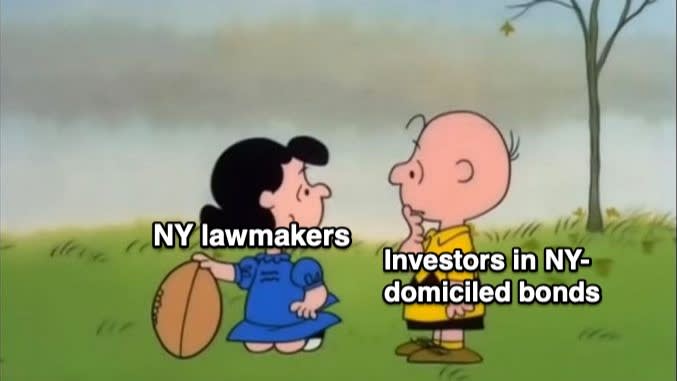
Out of nowhere, a deal of proposed costs that would considerably undermine the enforceability of sovereign personal debt contracts governed by New York regulation are wending their way as a result of the New York Condition Assembly and Senate.
This mischief appears in three draft regulations. 1st, the so-termed “orderly restructuring” monthly bill (A2970, S4747) would cap creditor recoveries at an (indeterminate) volume equal to what the US federal authorities could have obtained had it been a creditor — and retroactively lessen present judgments. Below is the ostensible function:
. . . The legislature finds that it is a longstanding plan of the United States and the state of New York, as the world’s major money center, to help orderly, collaborative and helpful intercontinental personal debt aid for developing countries with unsustainable ranges of debt. Credit card debt distress, debt crises, and disorderly default are linked with unacceptable human struggling, economic decline, and fiscal sector and payment units disruption. Furthermore, debt restructuring is ineffective and does not lead to sustainable results when it is not perceived as equitable or reputable by stakeholders in borrowing and lending nations. Moreover, general public lenders are not likely to take part in personal debt restructuring initiatives except if there is truthful stress sharing among the all general public and private creditors, which is vital to the legitimacy and performance of debt reduction initiatives. . . .
Second, the Assembly is thinking of a extensive regulatory plan that would empower New York point out courts to supervise sovereign credit card debt restructurings (A2102) when offering debtors the exclusive energy to propose a restructuring program. For good measure, that law would affect the full current sovereign financial debt inventory, given that it would implement retroactively and explicitly override the bond contract.
3rd, Assembly invoice A9317 (which has not nevertheless been reintroduced in this session), would reinvigorate the antiquated, discredited notion of champerty by requiring courts to ascertain a creditor’s subjective intent and building a presumption of wrongful function when a bondholder has any history of paying for sovereign credit card debt at a discount or declining to participate in a sovereign restructuring.
The said motivations make very little perception. 1 sponsor objects to so-referred to as “vulture funds” buying Puerto Rican personal debt. But the invoice applies substantially much more broadly: not only to unincorporated territories, but also to overseas international locations, provinces, and states (most likely anticipating debt issues that New York may possibly experience if existing trends continue on).
Placing aside major concerns of condition and federal constitutionality — and the risible notion that New York point out courts are proficient to oversee sovereign personal debt restructurings — the danger that these proposals could be signed into law wants to be taken severely. Constitutional difficulties consider decades (and charge thousands and thousands of pounds in authorized expenses) to take care of. If anything at all like these expenses is enacted, the hurt will long considering that have been done.
Since around 50 % of all sovereign bond contracts expressly count on New York regulation and New York courts, with the stroke of a pen, the proposed alterations would make it unattainable to enforce these contracts in accordance with their phrases — upending each the principal and the secondary markets for New York legislation bonds.
For a long time, borrowers and loan providers have expressly preferred to have their agreements adjudicated in New York, under New York legislation, because New York has been the gold regular: unequivocally guarding house rights, recognising the sanctity of deal, and making sure neutral, predictable, and reliable administration of justice. If those foundational principals improve, underwriters, bond potential buyers, and issuers will flee. It will not acquire very long for more beautiful jurisdictions, like London, to pick up the slack, producing New York to get rid of business enterprise — and tax income.
In addition, New York politicians can be expecting a large assortment of unintended repercussions: US pension resources and person buyers will endure losses, and New York’s standing as one of the world’s foremost commercial centres will be eroded. It is not a extend to foresee a destructive affect on the attractiveness of the US greenback as a reserve currency — a level of instability that is specifically sick-encouraged presented the willingness of China to wield sovereign financial debt as a coercive instrument of foreign policy.
Supplied that these spectacular changes feel palpably absurd, you’d be forgiven for wondering what is taking place at the rear of the curtain of lobbying, impact peddling, and political contributions. Considering that New York condition would be a selected loser, who would benefit? Who genuinely wins? Perversely, the largest beneficiaries of the degradation of America’s premier monetary and commercial centre as a bastion of contractual and property legal rights will not be sovereign borrowers, a great deal considerably less their citizens.
Instead, the biggest beneficiaries would be America’s enemies. China, Russia, Iran, Cuba, and North Korea are intent on degrading America’s status as a bulwark of the rule of regulation and undermining the greenback as a reserve currency. That all fits neatly with a motion — by now effectively under way — to establish solutions to the US greenback for settlement of global financial transactions and trade.
And China, a significant creditor to the world’s poorest nations, has a sturdy desire in undercutting the benefit of promises owed to other lenders. It is more than enough to be suspicious of who is truly driving this adjust. Sovereign lending is risky more than enough without officious meddling that upends longstanding legal frameworks and anticipations.
[ad_2]
Resource backlink